
In the 1930s, Radio had a problem. Procter & Gamble had an answer. Radio was the dominant medium. Daytime hours were going unused. The radio executives did not know how to fill that time. P&G figured it out. They would not buy advertising time inside someone else’s show. They would produce the show. They would own the time, own the content, and deliver it directly to the audience they needed to reach.
They called it a soap opera. They invented the format. They owned the category for decades.
On February 12, 2026, P&G did it again.
The Golden Pear Affair launched on February 12, 2026. Fifty-five episodes, produced by Pixie USA in partnership with P&G Studios and dentsu Entertainment. The backers are calling it the first brand co-produced feature-length microsoap in the United States, per the launch announcement. The product is Native, P&G’s clean personal care line. The plot involves an international jewelry heist, a missing sister, and globe-spanning romance. Viewers decide in the first three seconds whether to swipe or stay. Distribution: TikTok, Instagram, YouTube, Facebook, and a proprietary app.
Behind the camera is Jonas Barnes, founder of Pixie USA and a veteran of Original Film, the production company behind Fast & Furious, Sonic the Hedgehog, and S.W.A.T. Barnes did not stumble into micro-drama. He built a studio specifically designed to embed brands into vertical storytelling at the moment of production. Not as an afterthought. When a producer with that résumé bets his next company on a format, the format is worth paying attention to.
P&G did not buy a placement inside someone else’s show. They made the show. Ninety years later, the instinct is identical. The medium is different. The phone is the television. The swipe is the channel change. The model is the same.
What Is a Micro-Drama
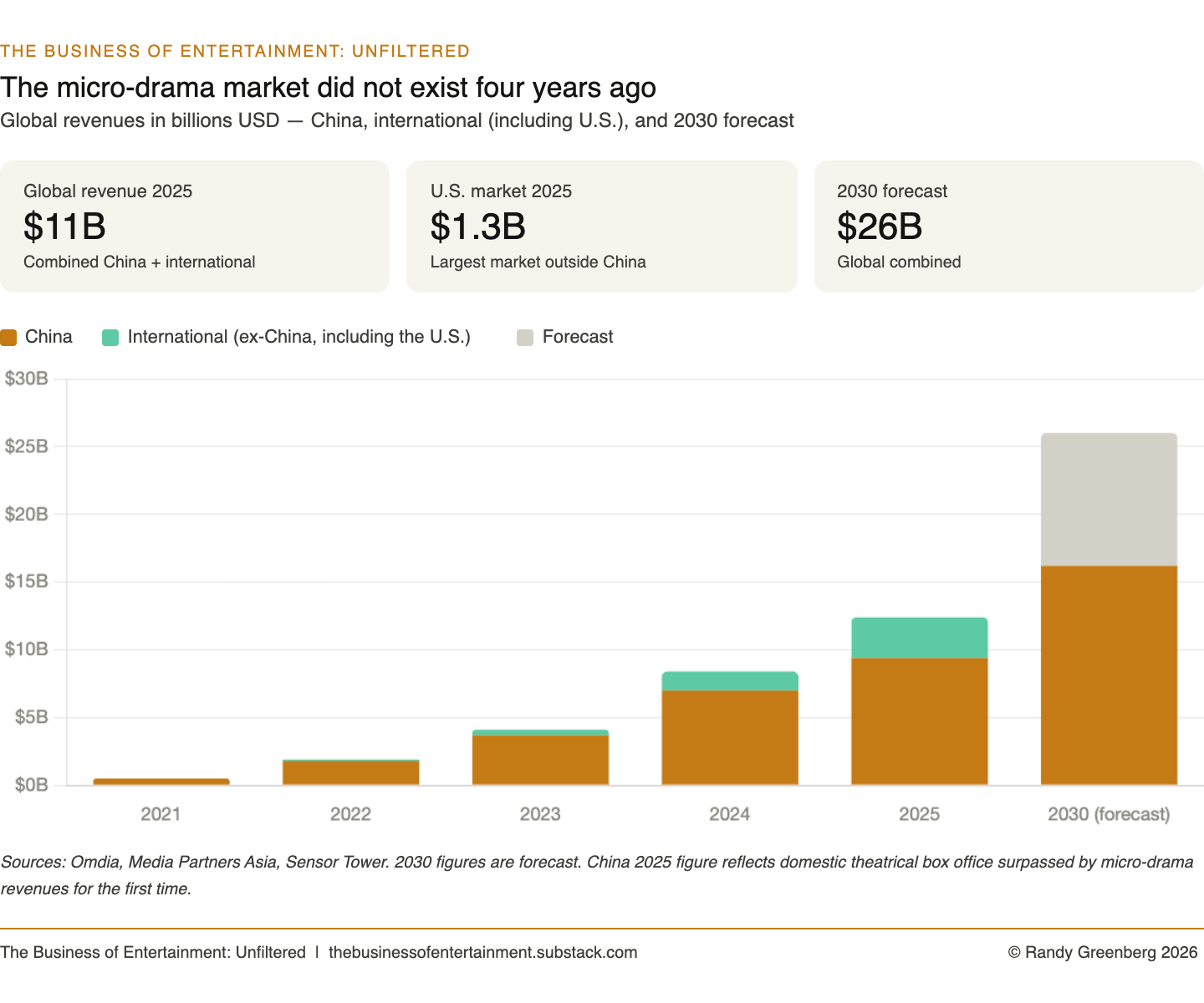
A micro-drama is a serialized vertical video story. Each episode runs between 60 and 90 seconds. Shot in 9:16 format for mobile viewing. Built around cliffhangers designed to make the viewer tap immediately to the next episode. The format originated in China, where it is known as duanju. It began on short-video platforms around 2018. By 2024 the Chinese market was generating $7 billion annually, per Media Partners Asia. In 2025 Chinese micro-drama revenues surpassed the country’s entire domestic theatrical box office for the first time, reaching $9.4 billion, per Media Partners Asia.
The format has crossed over. The global micro-drama market outside China generated $1.4 billion in 2024 and crossed $3 billion in 2025, per Media Partners Asia. The United States is the largest international market. Global revenues across both markets hit $11 billion in 2025, per Omdia. By 2030 the forecast is $26 billion, per Omdia.
The two dominant Western platforms are ReelShort and DramaBox, both China-originated. ReelShort generated approximately $400 million in revenue in 2024, per Media Partners Asia. DramaBox generated $323 million and was the only major platform to post a profit, $10 million in net income, per Media Partners Asia. In July 2025 DramaBox was selected to join the Disney Accelerator program, per Variety. Former Miramax CEO Bill Block launched GammaTime in October 2025 with $14 million in seed funding and 22 original series at launch, per Deadline. CSI creator Anthony Zuiker is writing two of them. Block’s Chief Content Officer is a Quibi veteran. His Chief Revenue Officer came from Google Gaming. When a producer who ran Miramax bets his next company on 90-second episodes, the format is no longer a curiosity. It is a business.
A note on production economics. A full micro-drama series of 50 to 60 episodes costs between $100,000 and $600,000 to produce, per industry estimates reported by Variety. A single episode of prestige television costs $10 million or more. A 30-second Super Bowl spot costs $7 to $8 million to air and another $1 to $3 million to produce. For that same $8 to $10 million a brand could produce 15 to 20 complete micro-drama series, own all of the content, control all of the distribution, and reach an audience that is actively choosing to watch rather than waiting for the skip button. The economics are not comparable to anything else in the entertainment marketing stack except influencer content, which the brand also does not own and cannot reuse.
This is not a fad. It is infrastructure. And brands are starting to figure that out.