


Alex Walton is building again.
Two weeks ago, Walton departed WME Independent, the international film sales division he helped lead inside the agency. Deb McIntosh stays, but her purview is North America rights only. WME, which once marketed itself as the only major agency combining domestic packaging and international sales under one roof, just became every other agency.
This is not the first time Walton has made this bet. He co-founded Bloom in 2014, building it into one of the more respected international sales boutiques of its era. WME acquired a majority stake in Bloom in 2017. Walton stayed, folded Bloom into Endeavor Content, then helped rebuild the international sales function inside WME as WME Independent. Now he is leaving to build independently again.
His departure lands at the start of the Cannes Film Festival, the single most important market for international film sales on the planet. The timing is not coincidental. It is instructive.
The independent international sales market Walton is returning to is not the one he left when WME bought Bloom in 2017. It has been restructured at the foundation. The question worth asking, as buyers and sellers converge on the Palais des Festivals for nine days of deal-making, is whether that restructuring has bottomed out and what the business looks like on the other side.
HOW THE MARKET WORKS AND WHY IT MATTERS
When an independent film gets made outside the studio system, it needs to sell territorial distribution rights country by country to finance and recoup its budget and generate returns. A German distributor buys Germany. A French distributor buys France. A Japanese distributor buys Japan. Across 50-plus territories worldwide, those deals add up.
The international sales agent sits between the producer and those territorial buyers. They represent the film at markets - Cannes, Berlin, the American Film Market, Toronto - pitch it to distributors, negotiate the deals, and earn a commission on the minimum guarantees those buyers pay. On a well-packaged film with recognizable talent, pre-sales of territorial rights can happen before a single frame is shot. Those pre-sale commitments can then be used to secure production financing.
For decades, this system worked predictably. A strong independent film could sell 20 to 35 territories with meaningful minimum guarantees across Europe, Asia, and Latin America. Producers used those pre-sales to close the financing of their budgets.
That model has been broken.
THE NUMBERS
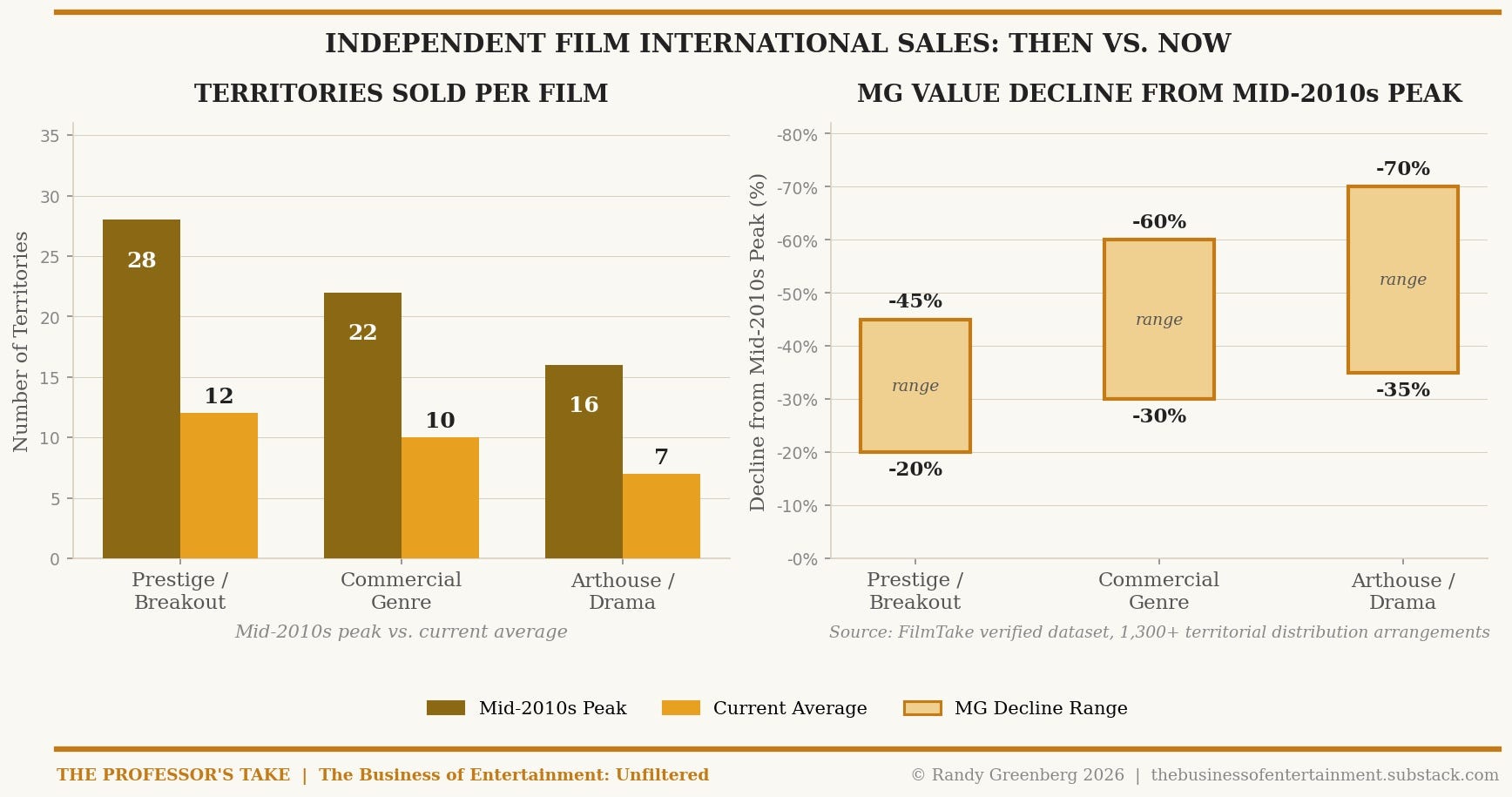
According to FilmTake’s most recent verified dataset drawn from over 1,300 territorial distribution arrangements, the typical post-premiere independent film now sells between 10 and 14 territories, roughly half the count of a decade ago. Total deal values are down 30 to 70 percent from the mid-2010s baseline. Films that once closed 25-plus territories now routinely close in the 8 to 18 range.
The territory-by-territory picture tells the story more precisely.
France remains the most stable market, and the reason is structural. French law mandates a chronological window system - theatrical runs exclusively before any platform can access the film, followed by pay TV, SVOD, and free TV in sequence. Netflix cannot compress that window in France the way it can elsewhere. The CNC, France’s national cinema center, levies contributions from ticket sales, broadcasters, and streaming platforms and recycles them into production and distribution funding. French distributors acquire knowing each downstream window will generate real revenue in order. That predictability supports higher minimum guarantees than buyers in unregulated markets can justify. It is the exception, not the rule.
Japan still pays for the right film, rewarding emotionally resonant storytelling, prestige positioning, or distinct genre craft. If a film does not fit those criteria, there is simply no sale.
Germany, Italy, Spain, the Nordics, and Benelux have all seen advances fall between 30 and 60 percent compared to the mid-2010s peak. Tobias Lehmann, managing director of Munich-based Alamode Film, put it plainly in a Screen International roundtable: if a film does not perform in Germany, it lands at 10,000 admissions and exits with no path to meaningful home entertainment revenue. Todd Olsson, president of international sales at Highland Film Group, put the European downstream collapse in the starkest terms of any executive speaking this week from Cannes, per The Ankler May 12, 2026: “You’ve got all the European distributors twisting in the wind. The offers you’re getting are literally just going to be against transactional and maybe home entertainment, and then if they don’t get a streamer to back them or a nod from TV, there’s nowhere to go.”
Latin America has compressed sharply, with most buyers defaulting to flat-fee digital licenses or aggregator arrangements. China is effectively closed to foreign independent films. The GCC and Middle East are among the few regions showing genuine resilience, particularly for cast-driven thrillers and commercial fare.
The cause is not mysterious. Pay-TV and Pay-1 output agreements, once the backbone of predictable downstream revenue that justified higher minimum guarantees, have largely evaporated. Streamers, which briefly replaced them, have pulled back. Lehmann again, per Screen International: Amazon “don’t [sic] want to have arthouse fare anymore. It is pretty clear they are no longer interested.”
The result is a market polarizing between two extremes. A-list prestige packages at the top of the market still command competition and real money. Sub-$5 million high-concept genre films at the bottom still sell reliably. Front Row Entertainment CEO Gianluca Chakra, speaking from Cannes this week, per The Ankler May 12, 2026, named the sweet spot directly: under $5 million budget, enough commercial hook to sell, small enough that a failure does not sink the company. The commercial mid-budget middle - star-driven action, thriller, and comedy in the $15-40 million range - is hollowing out. New North American buyers have emerged to fill the gap. But the early returns are sobering. Row K was the most-watched new entrant after buying four films at the most recent Toronto festival - and has since effectively collapsed. Backer Media Capital Technologies is pivoting away from the model, and Megan Colligan departed as president over a difference in strategic outlook. The poster child of the new movement became a cautionary tale within months. 1-2 Special has been steadily active and Black Bear is expanding into US distribution, but one anonymous UK seller assessed the field accurately, per Screen International, May 8, 2026 ahead of Cannes: “None of them has a pay-1 deal, so they’re all in exactly the same boat. They’re not offering minimum guarantee deals because they can’t.”
One veteran UK distributor, speaking anonymously to Screen International, May 8, 2026, offered the bluntest assessment available: “These are the worst economic conditions for the independent marketplace I’ve seen in 30 years.”
Paid Subscribers get: The Professor’s Notebook, How The Market Is Adapting, Who Controls the Market, What Turns This Around, and The Verdict. Get your Subscription Today
